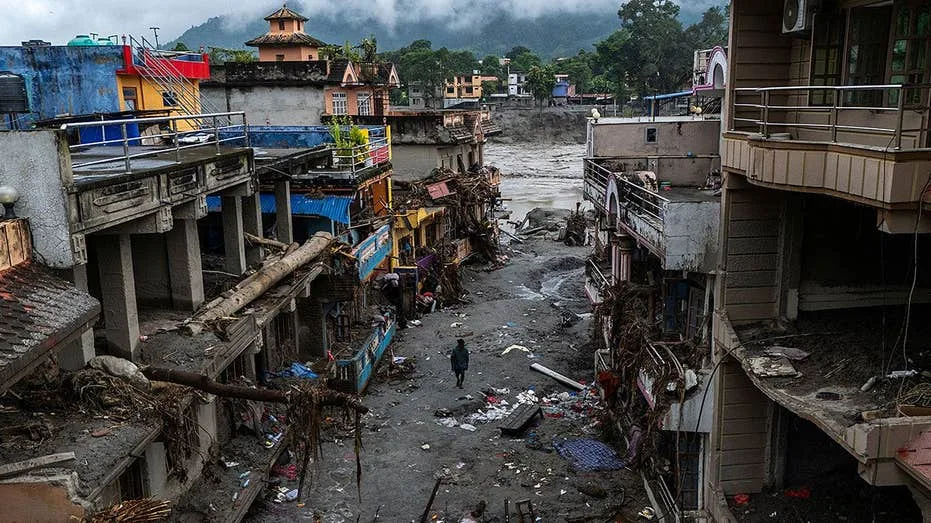
The U.S. State Department has confirmed that approximately 80 American citizens remain unaccounted for following a devastating Himalayan flood last Wednesday, which has resulted in hundreds of fatalities. This updated figure represents a slight reduction from an earlier estimate that placed at least 90 Americans as missing in the area near the Nepal-China border.
Casualties and Search Efforts
Meanwhile, local officials in Nepal reported on Sunday that the nation's death toll from the disaster has tragically increased to 903. The number of individuals still missing has nearly doubled, now estimated at around 4,200. A spokesperson for Nepal's Ministry of Foreign Affairs provided an update on Sunday regarding the extent of the catastrophe.
So far, 903 bodies have been recovered from the areas and about 4200 people are still unaccounted for. Over 10,000 people have been rescued from the regions, including over 323 foreign nationals. As per the available data, about 590 foreign nationals are still missing, from 39 countries.
Understanding the Catastrophe
The disaster, which unfolded in north-central Nepal, was triggered by a distant slope failure involving a glacier. This event initiated a rapidly moving debris flow that traveled approximately 62 miles downstream before impacting a populated area. Visual records of the incident depicted an immense surge of water and debris tearing through valleys, engulfing structures in its path.
International Relief Operations
Nepalese authorities are actively coordinating with neighboring nations and the broader international community to deliver essential relief. Supplies have already begun arriving from countries such as India and China. Further aid is anticipated from various countries and international organizations, including the United States, United Arab Emirates, Myanmar, Qatar, the United Kingdom, Australia, the Republic of Korea, Japan, New Zealand, Malaysia, Singapore, Bangladesh, and Pakistan.
The Ministry of Foreign Affairs spokesperson expressed gratitude, saying, "Relief and humanitarian assistance are being provided in the affected areas. We are deeply grateful to our friends and partners for their solidarity, goodwill and generous offers of support at this difficult time."
The U.S. State Department had previously announced last Wednesday its commitment to "monitoring the situation and is deploying a disaster response advisor to the region to support response efforts." The department also stated its intention to "provide $500,000 in assistance through its global award with Catholic Relief Services, supporting emergency shelter, relief items, and water, sanitation, and hygiene assistance to flood-affected communities."
Geological Insights into the Disaster
Investigators from the U.S. Geological Survey (USGS) are still working to determine the precise nature of the initial failure. They remain uncertain whether the event was a landslide that incorporated a portion of a glacier or a glacial collapse, where a segment of a glacier detaches and rapidly moves downslope with surrounding debris.
The glacier-related incident generated a magnitude 5.2 earthquake, according to USGS data. A second seismic event, equivalent to a magnitude 4.2 earthquake, was recorded approximately three hours later. The agency elaborated on the destructive flow, explaining:
The glacial debris contained water and ice that rapidly melted, picking up more material and water as it flowed downslope in the existing stream and river channels, creating a fast-moving, far-traveled landslide and flood laden with boulders and other rubble.